
Puzzle knowledge · Count the border once
How Many Edge Pieces Does a Jigsaw Puzzle Have
Quick summary
A rectangular jigsaw with r rows and c columns has 2r + 2c − 4 edge pieces, including the four corners, provided both dimensions are at least two. An 8-column, 6-row puzzle therefore has 24 border pieces. Of those, four are corners and 20 are noncorner edges.
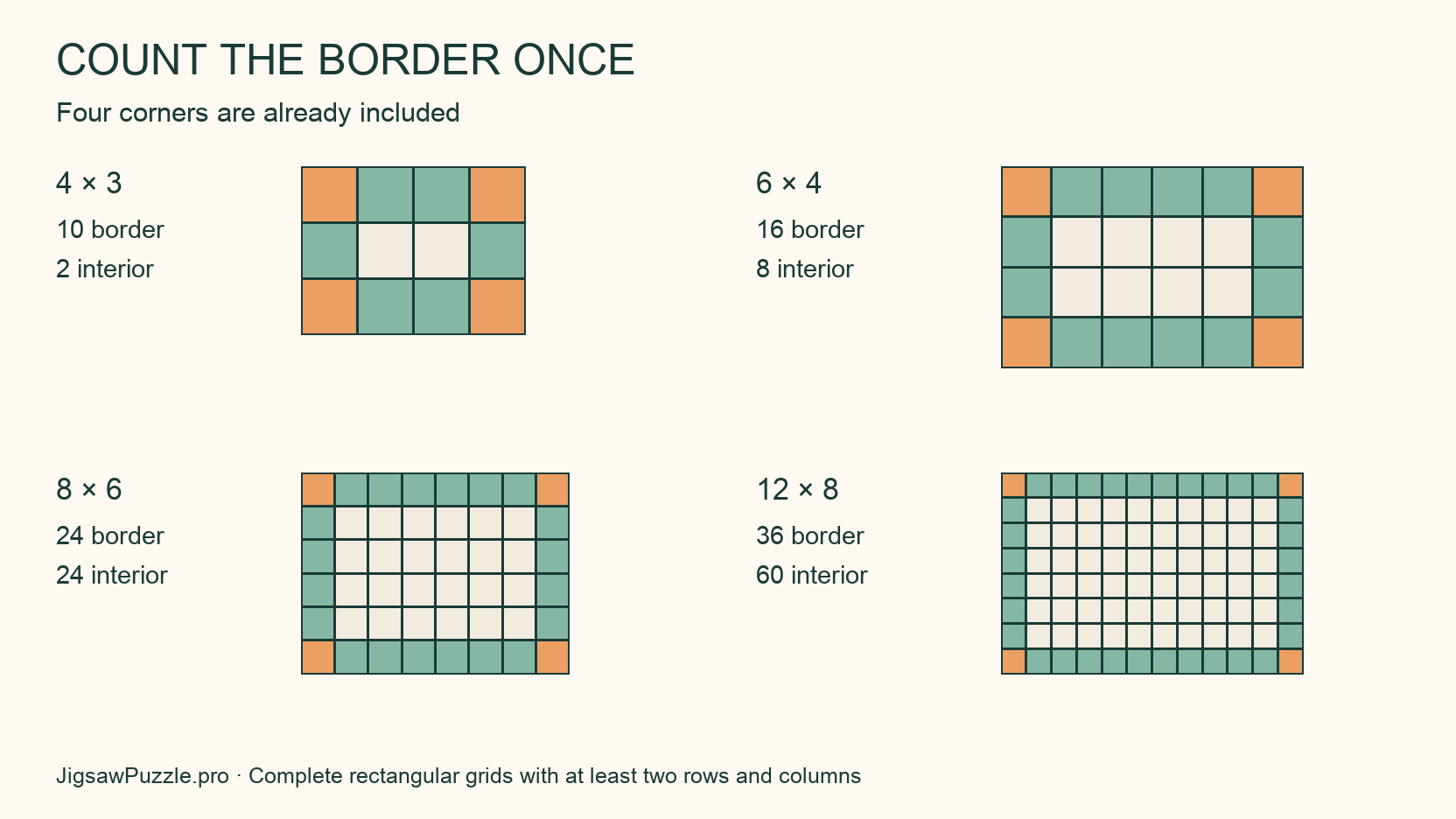
We checked the four grids used by JigsawPuzzle.pro against its piece generator and counted their boundary cells independently. The diagrams below show those counts. They use plain cells so you can follow the arithmetic without tracing tabs and blanks.
Key takeaways
- 01Count corners within the border total, then subtract four if you need only noncorner edges.
- 02Use rows and columns, since the total piece count can fit more than one rectangle.
- 03Apply the formula to a complete rectangular grid with at least two rows and two columns.
Define the rectangular grid
Let r be the number of rows running from top to bottom, and c the number of columns running from left to right. Multiply them to get the total piece count, r × c. A 4 × 3 grid in this guide means four columns and three rows, making 12 pieces.
A border piece touches the outside boundary. Here, the edge-piece count includes corners. If you sort pieces with exactly one flat outside side into one pile and corners into another, add both piles before comparing with the formula. Leaving out the corner pile makes your count four smaller.
Use the piece-name diagrams to distinguish corners, noncorner edges and interior pieces.
Count the border without counting corners twice
Count the full top and bottom rows first. Together they contribute 2c pieces. Now count the left and right columns, leaving out their top and bottom corners. Each side contributes r − 2 more pieces. The result is 2c + 2(r − 2), which simplifies to 2r + 2c − 4.
Adding two full rows and two full columns counts every corner twice. Remove one count for each corner, and every border piece is counted once. All four physical corner pieces remain in the result.
You can check the interior formula by removing the outer frame. The remaining rectangle has two fewer rows and two fewer columns. Multiply its dimensions, then add the interior count to the border count. Their sum should match the original number of pieces.
Work through four real grid examples
These are the site’s current grids. Orange cells are corners, green cells are the rest of the border, and pale cells are interior pieces. The numbers in the corners identify four separate cells. The drawings show grid positions rather than the game’s shaped cuts.
| Columns × rows | Total | Border incl. corners | Noncorner border | Interior |
|---|---|---|---|---|
| 4 × 3 | 12 | 10 | 6 | 2 |
| 6 × 4 | 24 | 16 | 12 | 8 |
| 8 × 6 | 48 | 24 | 20 | 24 |
| 12 × 8 | 96 | 36 | 32 | 60 |
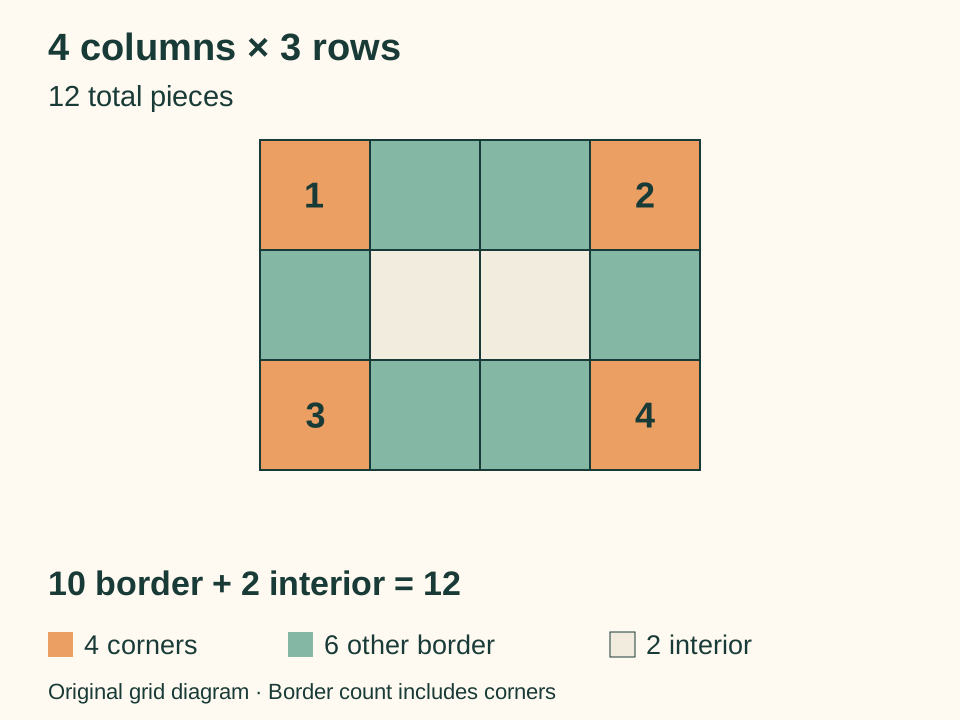
For 12 pieces, count four across the top and four across the bottom. Only the middle row contributes additional side pieces, one at each end. That gives 4 + 4 + 1 + 1 = 10. The two cells between them are interior pieces.
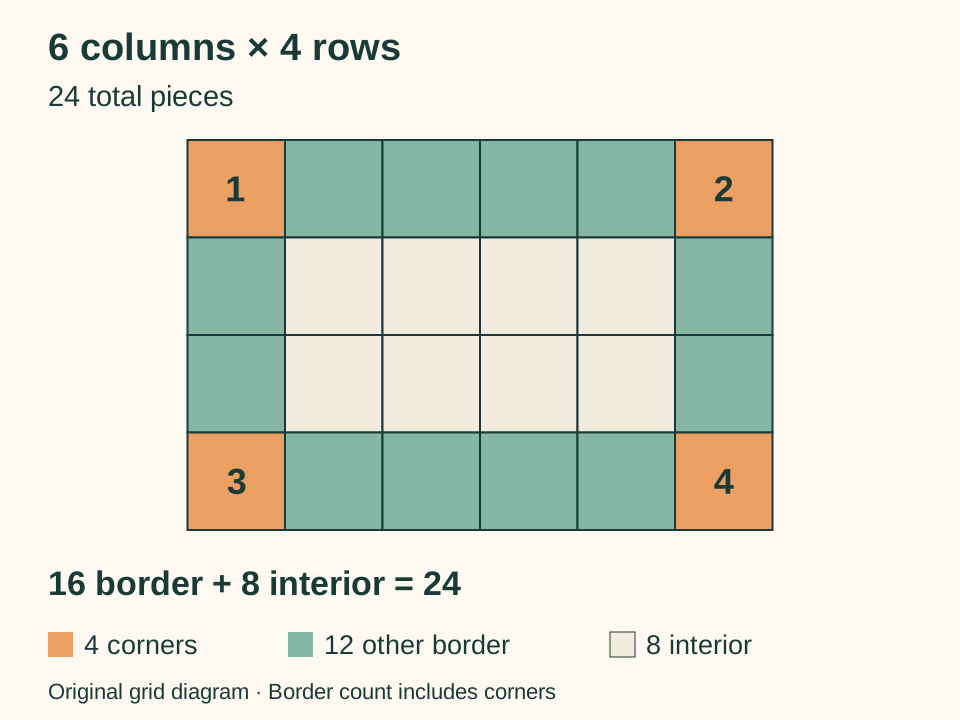
For the 24-piece grid, the calculation is 2 × 4 + 2 × 6 − 4 = 16. Removing the frame leaves a 4-column, 2-row center containing eight pieces. The check is 16 + 8 = 24.
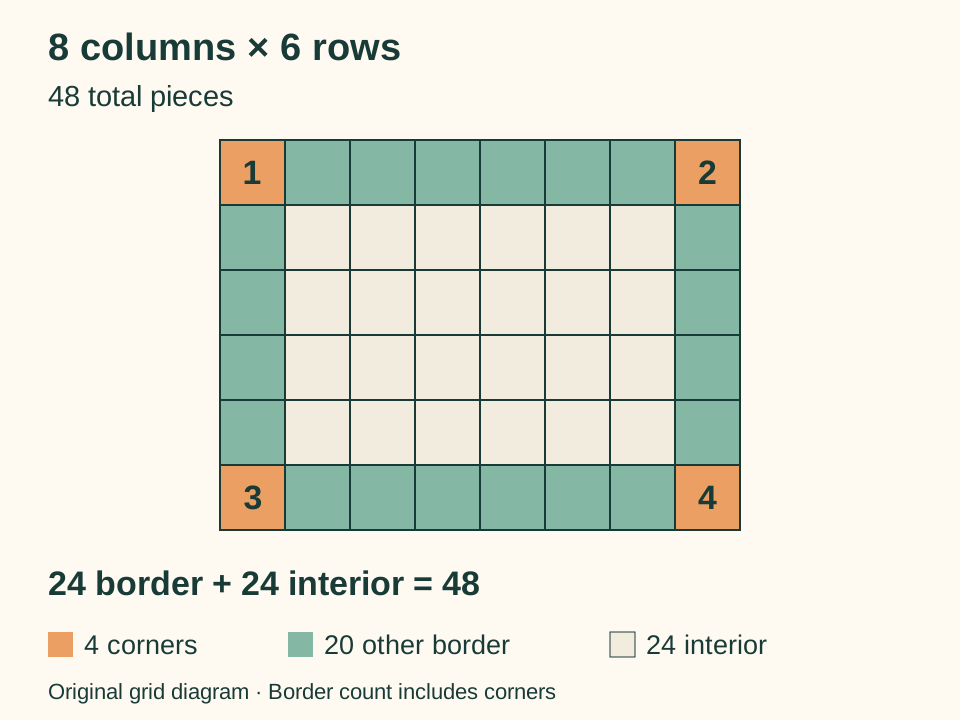
For 48 pieces, the border is 2 × 6 + 2 × 8 − 4 = 24. The interior is 4 × 6 = 24 as well. Equal counts happen for this rectangle; the other examples show why half the pieces is not a general border rule.
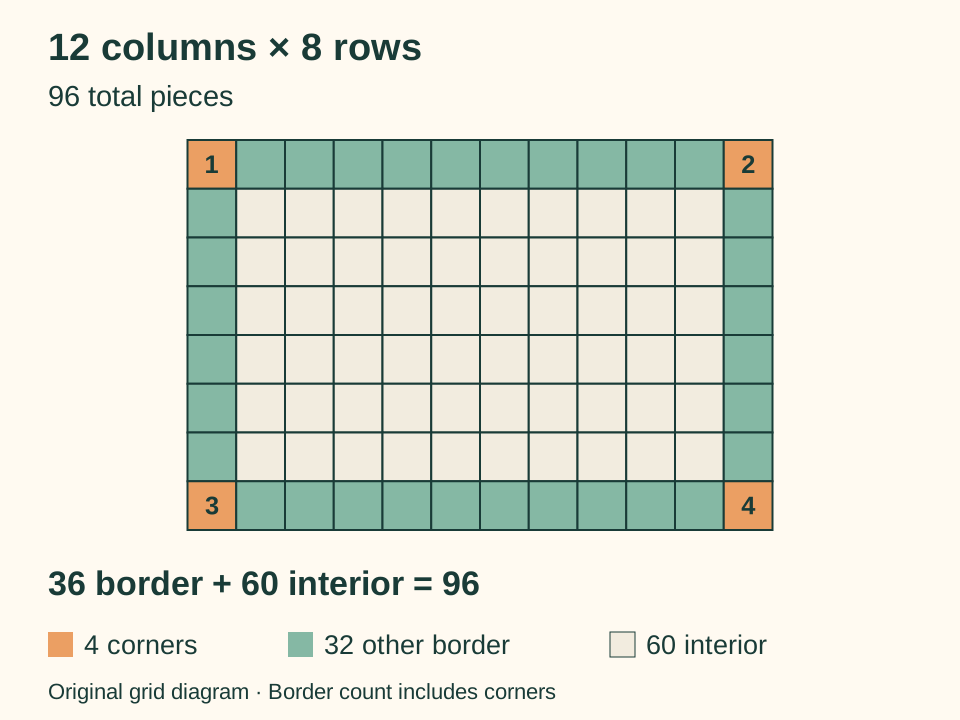
For 96 pieces, the 12-column, 8-row grid gives 36 border pieces. Subtract four to get 32 noncorner edges. The interior has 10 × 6 = 60 cells. Checking 4 + 32 + 60 = 96 keeps all three groups separate.
Why a piece total does not fix the border count
Consider another rectangle with 96 pieces, arranged in 16 columns and six rows. Its border would contain 2 × 6 + 2 × 16 − 4 = 40 pieces. That differs from the 36 around the site’s 12 × 8 board. The 16 × 6 arrangement is a mathematical example, not an additional game setting.
If you know only the total, several factor pairs may be possible. Count the actual positions along the top and one side, or consult a reliable grid specification. The finished picture’s width and height alone do not tell you how many pieces occupy those sides.
Know when the formula does not apply
Both r and c must be whole numbers of at least two. A two-row rectangle is allowed. Every piece belongs to the border, and the interior formula gives zero. A single-row strip needs separate treatment because the top and bottom rows are the same row.
Random cuts, shaped outlines and incomplete grids may lack consistent rows and columns. Count their actual boundary pieces directly. An internal hole also creates a boundary that the outer-rectangle formula does not include.
To check a rectangular board, write down its rows and columns. Calculate the border including corners, then the interior. Their sum should equal the total. If it does not, recheck the arithmetic and make sure the corners appear in only the border group.
Sources and further reading
Frequently asked questions
Next move
Check a grid you can play
Use the actual grid dimensions in the difficulty chart, then identify its outside pieces on a board.