
Shared screen activities · One control, a clear handover
A Turn Taking Jigsaw Game for Two People on One Device
Quick summary
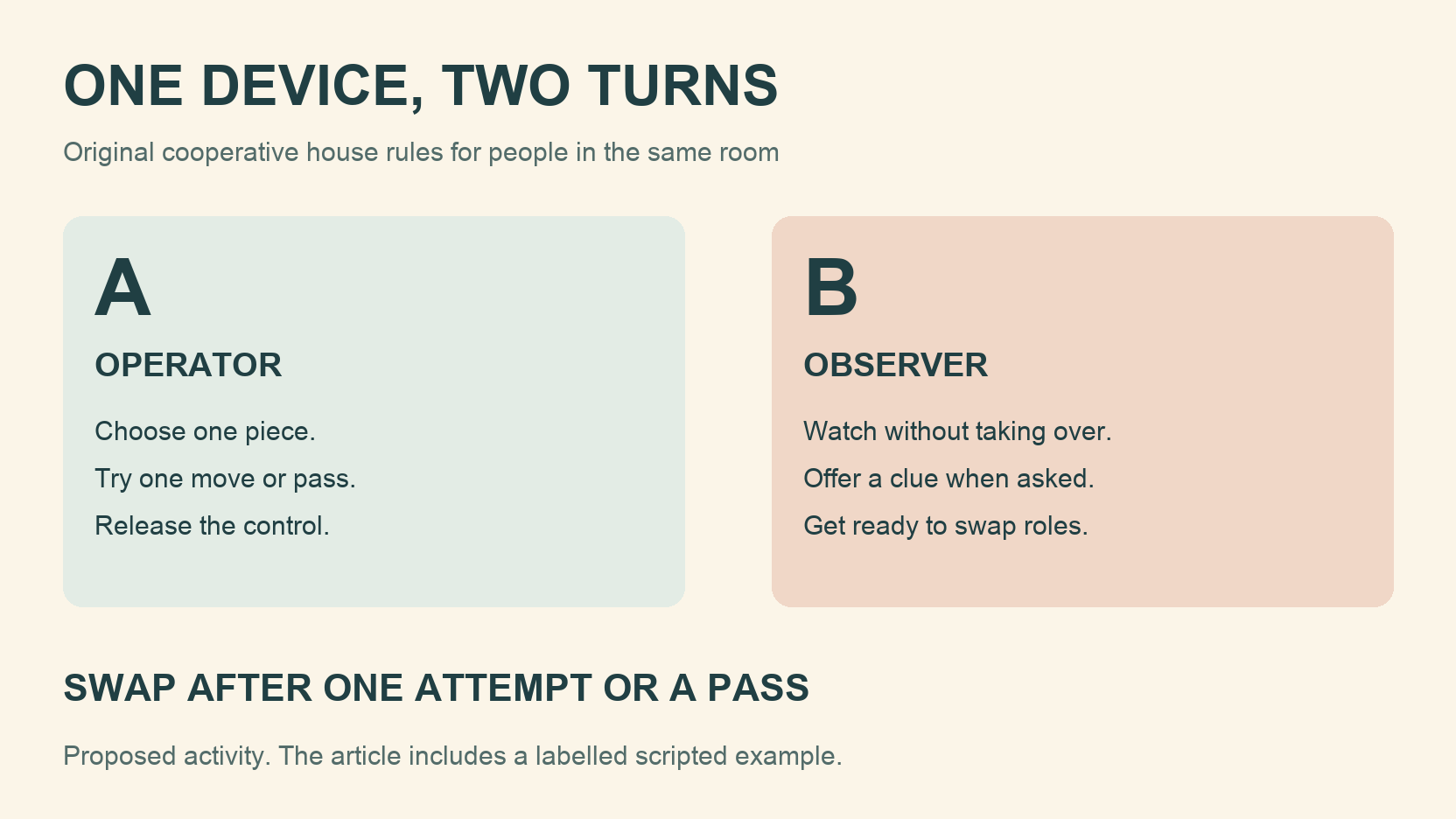
Give the mouse to one person and give the next turn a clear ending. In this proposed turn taking jigsaw game, each operator makes one deliberate attempt or passes, then releases the control. A successful join earns no extra turn.
This is an original cooperative rules proposal for two people in the same room. The two-round example is scripted, and we have not run a two-person human trial. JigsawPuzzle.pro supplies one board and one shared game timer. It has no multiplayer synchronization, shared rooms or separate player timers.
Key takeaways
- 01Keep one input controller active while the other person observes.
- 02Swap after an attempt or a pass, whether or not a piece connects.
- 03Ask both people about participation before another round.
Choose one board both people can see
Open the gallery together and pick a picture whose details are comfortable to inspect from both seats. Start with Easy at 12 pieces or Medium at 24. Hard has 48 and Expert has 96. A smaller count leaves less searching to manage while learning the handover rule.
Choose a shared picture in the puzzle gallery.
On a computer, share one mouse or trackpad. On a tablet, let only the current operator touch the screen. Put a small paper marker beside that person. The marker is your own reminder, and the website does not assign or track these roles.
Agree on the reference picture before starting. You can leave it available to either operator. Keep that agreement for both people, and let the operator handle reference and zoom controls during their turn. Avoid reaching across to change the view while your partner is dragging.
Assign the operator and observer roles
The operator chooses what to try and controls the pointer. The observer watches with hands away from the input device. Offer a clue when the operator asks for one, then leave the decision with them.
In this one device jigsaw activity, seeing a promising connection does not transfer control. Wait for the operator to finish, even when you think you know the answer. Your next turn gives you a separate choice.
Agree on how much discussion you both want. You can allow open suggestions or use the invitation-only clue rule. Keep the same agreement when the roles swap.
End a turn after one attempt or a pass
Choose a piece and make one deliberate placement attempt. Release it, look at what happened and finish the turn. If it does not connect, you still hand over. If you choose to pass, move the paper marker without making a drag.
A connected group may move together when dragged. Count that movement as one attempt too. A quick movement still ends the turn, leaving the next decision to your partner.
For the handover, finish the drag and lift your hand completely. Move the marker to your partner, who then takes the input device. Do not pull the mouse away while a piece is still being held. One round ends after each person has had one operator turn.
Download the original cooperative rule card.
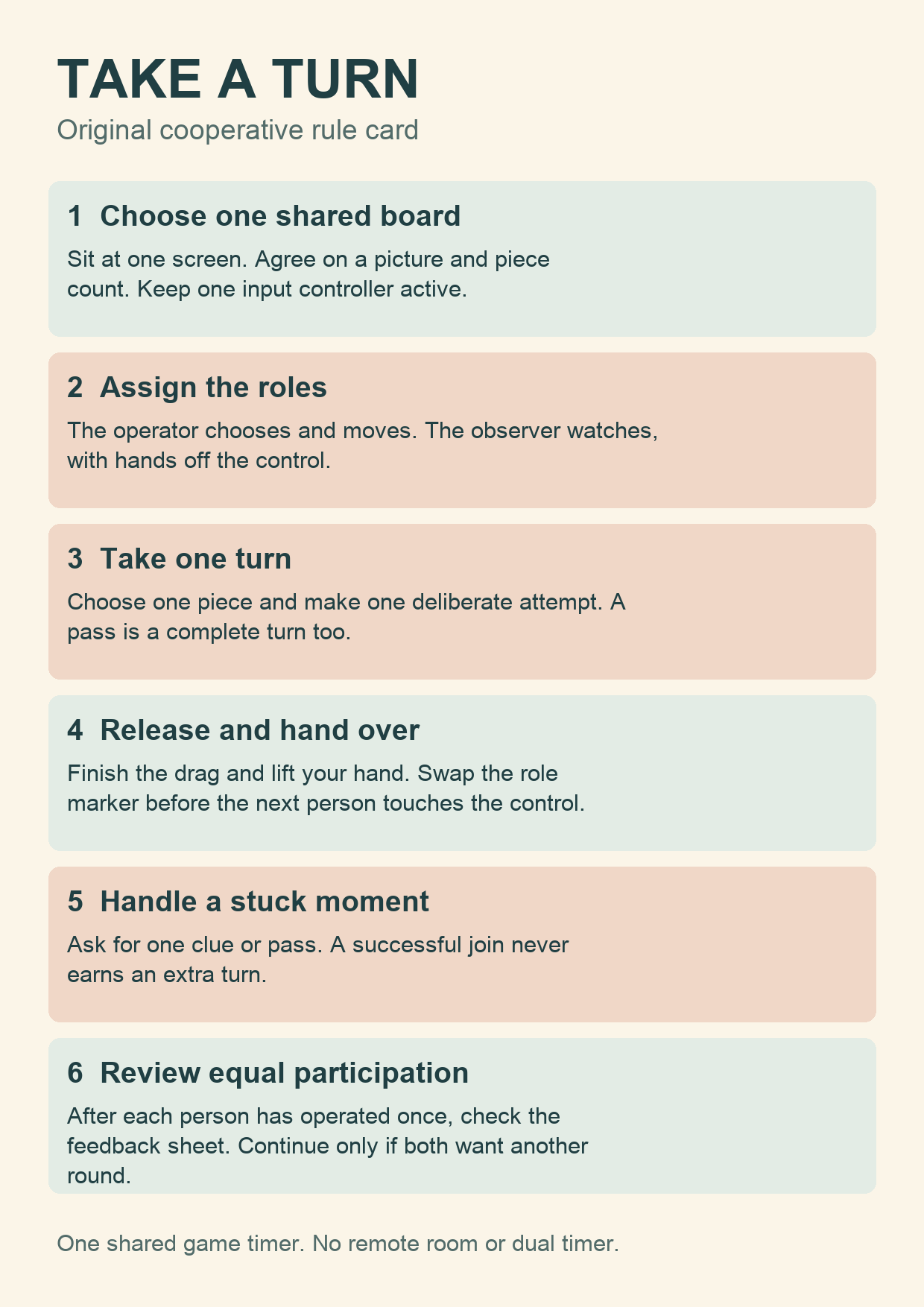
The site’s timer belongs to the shared board. It does not decide when to swap or measure each person’s contribution. Use the marker and the agreed action limit for handovers. This activity needs no separate player clocks.
Make room for a stuck turn
Use the adult picture-description script when you want to practise English together.
Before playing, agree that a person can ask for one clue or pass. A pass ends the turn, even when the observer already has a possible answer.
After a clue, the operator can try one move or pass. The observer should not take over the pointer to demonstrate the answer. If a piece fails to connect, leave it somewhere both people can find it and complete the handover.
Review the solving guide together if you both want help choosing a next step.
Two scripted rounds with a clear handover
The following is a hypothetical demonstration of the rules, not a record of people playing. A and B are example roles. The outcomes simply show that a failed attempt, a pass and a successful connection all lead to the same handover.
| Round and operator | Example action | Handover |
|---|---|---|
| Round 1, A | A tries a mountain-edge piece. It does not connect. B watches without touching the control. | A releases the piece and passes the marker to B. |
| Round 1, B | B cannot choose a promising piece and uses the agreed pass. | B moves the marker to A. Both have now had one turn. |
| Round 2, A | A asks for a clue, chooses a piece and makes a connection. | A releases the control. The connection gives no extra turn. |
| Round 2, B | B tries one nearby piece. It does not fit, so B leaves it visible. | B releases the control and ends the round. |
Separately, we checked the current browser controls in Chrome on October 29, 2026. A 12-piece Mountain Sunset board accepted two separate drag-and-release actions and opened the reference picture. That was an automated single-input control check, with the board unfinished. It provides no evidence about how two people felt or whether this proposal improves cooperation.
Check whether both people had a choice
After a round, answer the feedback questions separately. Use yes, no or unsure. A completed board can still leave one person with little say, so review the choices each person had instead of counting only successful joins.
| Question for each person | What to discuss |
|---|---|
| Did I choose my own move or pass? | Whether the observer’s suggestions left room for a decision. |
| Did we each have one operator turn? | Any skipped handover or extra attempt. |
| Did my partner wait for me to release control? | Any moment when both reached for the input. |
| Could I ask for help without losing my turn? | Whether help became a takeover. |
| Would I like another round? | One change each person wants before continuing. |
Download the printable participation feedback sheet.
Keep the sheet on paper or your own device. It has no online submission. Finish after equal operator turns if both are comfortable continuing that far, or stop immediately when someone needs a break.
How this proposal relates to Puzzle Chess
The USA Jigsaw Puzzle Association’s Puzzle Chess rules use alternating placements in a competitive game with chess clocks. We consulted that example of a turn-based mechanism. Our cooperative proposal uses an attempt-or-pass handover and a participation review, without an opponent’s clock or a winner.
Conclusion
Leave the rule card beside the screen. Before starting again, agree on the one change each person requested and choose who will operate first.
Sources and further reading
Frequently asked questions
Next move
Try one shared round
Choose a picture together or review the solving steps.