
Choose your format · Find room for everyday play
Digital vs Physical Jigsaw Puzzles for Everyday Play
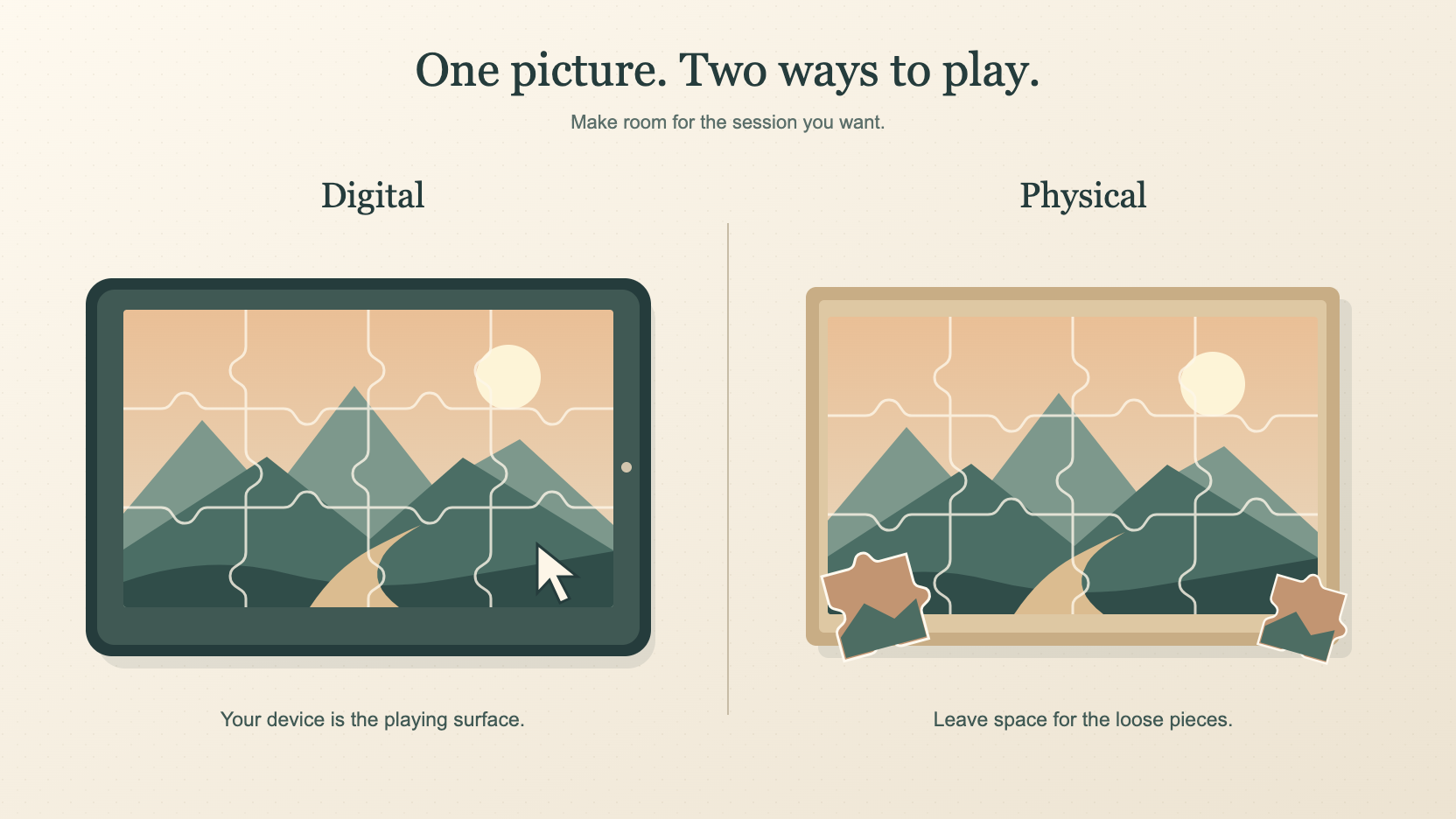
Quick summary
Digital jigsaw puzzles suit a short session when you have a device handy and need the table clear afterward. Physical puzzles suit a session where handling the pieces is part of the pleasure. When comparing digital vs physical jigsaw puzzles, start with the space and experience you want today.
We checked JigsawPuzzle.pro in Chrome for this comparison and read the published dimensions and storage details for physical puzzles. The browser controls and local-save behavior described here belong to this site.
Key takeaways
- 01Choose digital when a permanent puzzle surface is the main obstacle.
- 02Choose cardboard when you want to turn pieces in your hands or share a table.
- 03Check the actual service before relying on offline play or continuing on another device.
Compare the experience you actually want
Both formats ask you to connect picture details and piece shapes. The difference is how you inspect and move them. On a physical puzzle, you can pick up a piece, turn it over and test its fit with your fingers. In a browser, you drag a picture fragment with a mouse or touch screen and watch how it meets its neighbor.
If handling cardboard is your favorite part, a tablet cannot supply that texture. A physical board also lets several people reach different areas at once. A shared screen needs more turn-taking unless the service offers a separate multiplayer mode. JigsawPuzzle.pro currently provides individual boards.
For a screen-free evening, choose a physical puzzle. For a brief break beside your laptop, a browser puzzle is easier to keep within reach. You can decide this before comparing pictures or piece counts.
Space, touch and setup tradeoffs
Check the finished dimensions before opening a physical puzzle. Ravensburger lists its 1,000-piece Riverside Town puzzle at 70 × 50 cm. That is the assembled image; you still need somewhere for loose pieces and the box lid. Piece count alone cannot tell you whether the whole working area fits your desk.
A mat or board can help you reclaim the table. Ravensburger’s Roll Your Puzzle uses a felt mat, a tube and bands to store a board in progress. You still need a place for the rolled puzzle and room to open it next time. Measure that storage space too.
A browser board stays on your device, leaving no loose pieces on the table. A small screen limits how many fragments you can inspect at once. Zoom enlarges details while reducing the visible area. If you spend more time moving the view than examining pieces, try a larger screen before deciding that digital puzzles suit you poorly.
What changes when pieces are digital
On JigsawPuzzle.pro, pieces keep their original orientation. There is no rotation control. Matching neighbors join when you align and release them, and joined pieces move as a group. This removes the physical task of turning each loose piece to find its orientation. Picture details still matter, but the actions are different.
The game offers zoom controls and a reference image. Those tools help you inspect fragments without holding them nearer your eyes. A digital piece cannot fall under the sofa, though it can sit outside your current view or hide beneath another piece. A screen changes where you look for a missing fragment.
Progress is saved in the same browser and device. That makes a short session practical, provided you keep that browser’s site data. It does not give this site cloud synchronization. Starting on your phone and continuing on your laptop requires a capability this site currently lacks.
Check features service by service. Jigsaw Explorer’s custom-puzzle help, for example, documents shareable puzzle links. JigsawPuzzle.pro currently has no public puzzle-sharing workflow. For a commute, plan to have an internet connection available; offline play is not a verified option for this comparison.
Choose a format for three everyday situations
Use this original decision table as a starting point. Each recommendation follows from the stated constraint. The last column identifies what could change it.
| Your situation | Start with | Reason | Check before committing |
|---|---|---|---|
| A seated commute with internet available | A browser puzzle | No loose pieces to spread out or pack away. | Connection quality, battery and whether dragging feels comfortable on your screen. |
| A small desk that must be cleared daily | Digital, or cardboard on a removable surface | Digital needs no dedicated board; physical storage can preserve the arrangement. | Finished dimensions, sorting room and where the mat or board will go. |
| An evening where you want to handle real pieces | A physical puzzle | Cardboard provides texture and lets you turn pieces in your hands. | Enough light and a protected place to leave the unfinished puzzle. |
For the commute, try dragging a few pieces while seated before beginning a longer board. For the small desk, measure the clear surface and compare it with the puzzle’s listed dimensions. If touch is the reason you want to play, borrow a physical puzzle before buying storage accessories.
When weighing online vs cardboard puzzles, you can keep both formats in your routine. Use the browser when the table needs to stay clear, and leave a physical board for evenings when you have room. If digital fits today, choose a picture in the gallery and test the controls on your own device.
Open the picture gallery and try a browser puzzle.
Use the difficulty guide when you are ready to choose a piece count.
Conclusion
After trying a few moves, check how it feels to stop. Can you put the device away and return to that browser later? Can you protect the physical board until tomorrow? Settle that question before beginning a longer puzzle.
Sources and further reading
Frequently asked questions
Next move
See whether a browser puzzle fits today
Choose a picture and try the controls on your own device. Your available space and the way the pieces feel to move will help you decide.