
Science activities · Read the process after rebuilding the picture
Rebuild a Water Cycle Diagram as a Jigsaw Activity
Quick summary
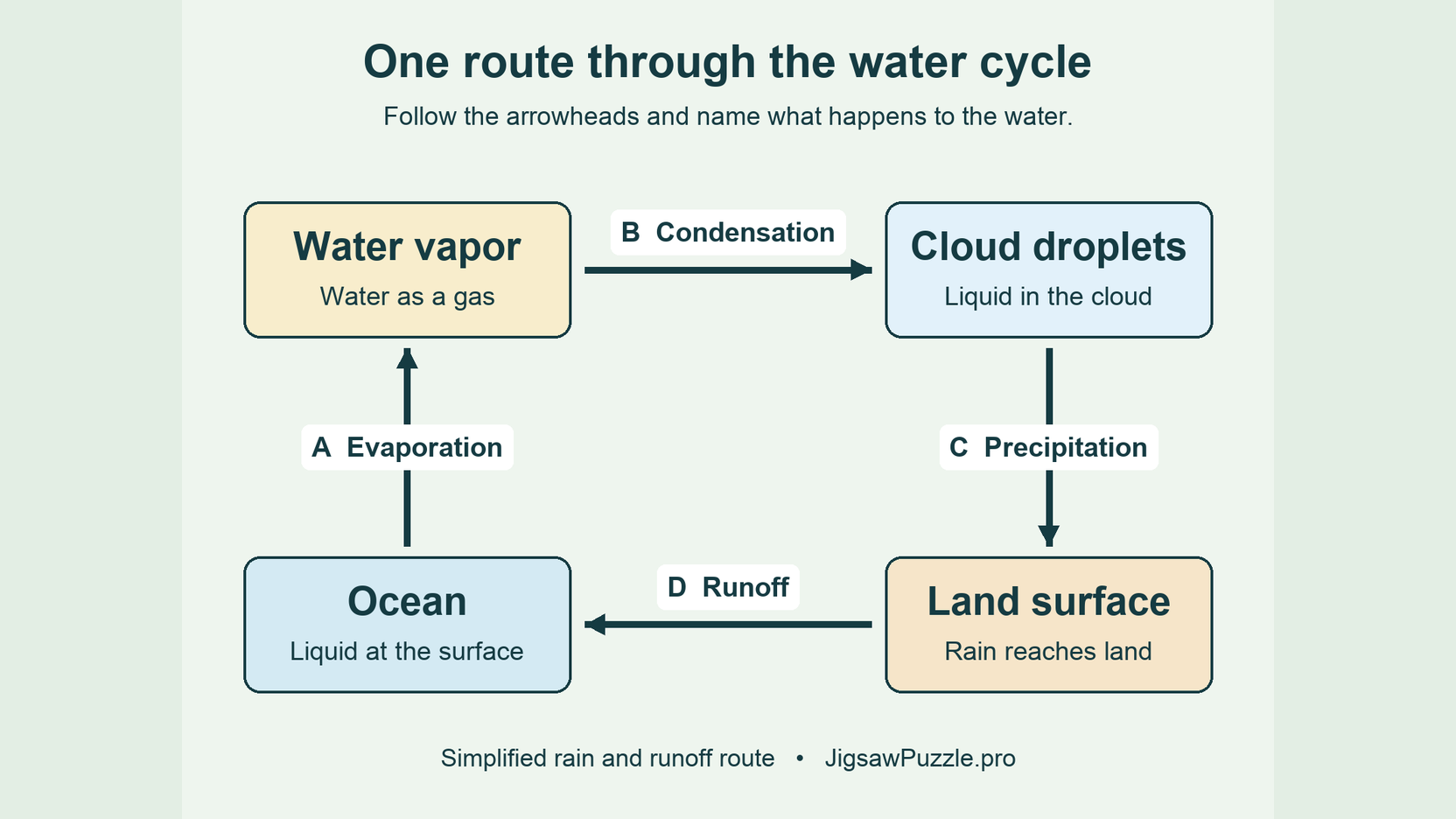
In this science diagram jigsaw activity, you rebuild a picture of one route through the water cycle. Then you explain what happens to the water along each arrow. A solver can fit every piece and still read the condensation arrow backward. That is the mistake this exercise gives you a way to catch.
Key takeaways
- 01Read the arrowhead before naming the process.
- 02Use the whole diagram to check your explanation.
- 03Keep the puzzle and the answer check as separate tasks.
Use a verified diagram and readable labels
The USGS water cycle materials show a much larger system, including water below ground and the ways people use it. NASA’s explanation helped us check the changes between liquid water and vapor. We drew one route for this activity so you can trace four arrows without hunting through a crowded poster.
The diagram follows water from the ocean surface into the air, through cloud droplets and down to land as rain. It then follows some of that rain back toward the ocean. Real water can take other paths. Rain can fall directly into the ocean, and some water that reaches land can enter the soil. You can start reading the drawing at any of its four boxes.
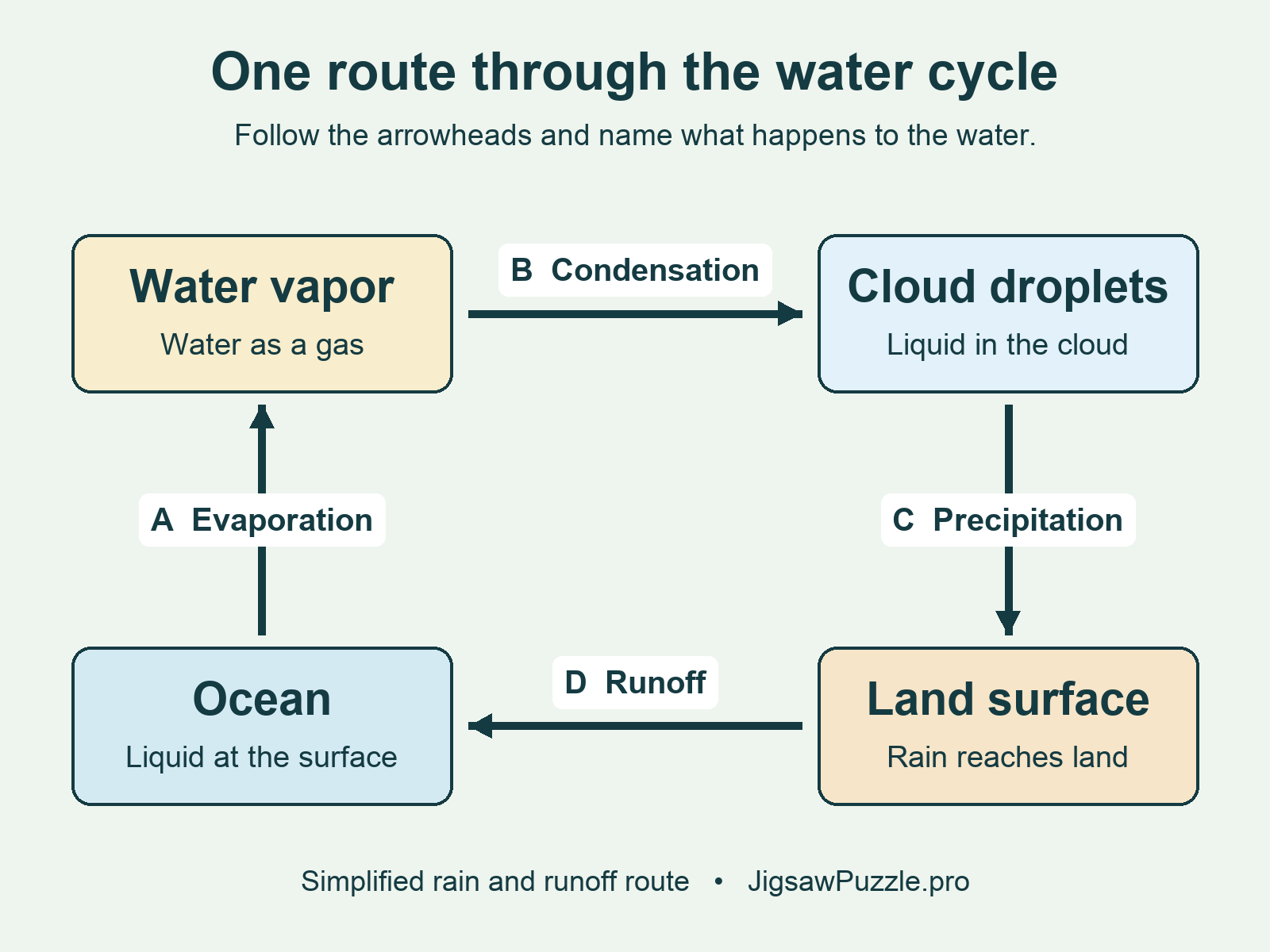
Download the original water cycle diagram PNG.
Open the PNG at the size you expect to use. Try reading Condensation and Precipitation without leaning toward the screen. Then point to the arrowhead for each word. If either is hard to see, use a larger display or open the full image beside the puzzle. A readable process name needs a readable direction too.
Ask process questions before solving
This water cycle jigsaw activity is written for adults and readers aged 13 and up, with adult supervision for minors. Give the solver a short look at the whole diagram before opening the puzzle. Ask them to choose one arrow they can explain and one they want to revisit. If you are working alone, write down a first answer to question B.
- On arrow A, where does the water come from and what form does it take?
- What changes along arrow B, and where does that change happen?
- What moves along C, and where does it go in this drawing?
- Follow D from its tail to its tip. Where can this portion of the rain go?
- Start at land. Which arrows take you to the cloud droplets again, and where does the water change state?
Keep the questions beside the game. In a pair, one person can trace an arrow while the other explains it. Switch roles on the next arrow. If the explanation stalls at the printed label, ask for a sentence that begins with the water and ends where the arrow points.
Rebuild the image and track the connections
Upload the PNG in DIY and choose Easy for 12 pieces. The diagram is already in the four by three proportions of the Easy board. Keep the original image open beside the game if you want to compare an incomplete section with the full drawing.
Try joining the two upper boxes first. A long dark line might help you find its neighbor, but a cut can cross a word or put an arrowhead on a different piece from its label. The puzzle maker cuts the picture by geometry. A piece might contain several clues, or only blank space.
Once the image is together, open the reference or the original PNG if a label is small. Point to the tail and then the head of B. Say what form the water takes at each end. Give the same attention to D, where the water stays liquid even though it moves to a different place.
Explain the arrows and check the answers
Compare two circuit diagrams and explain whether an open or closed path lets the lamp light.
In this diagram reconstruction puzzle, check each answer against the two boxes its arrow connects. Accept different wording when the direction and the process agree. On D, for instance, a description of water flowing downhill toward a river can be more informative than the word runoff on its own.
- 1
On arrow A, where does the water come from and what form does it take?
A begins at the ocean surface. Liquid water evaporates and enters the air as water vapor, a gas.
- 2
What changes along arrow B, and where does that change happen?
Water vapor in the air condenses into tiny liquid droplets. The cloud box represents those droplets.
- 3
What moves along C, and where does it go in this drawing?
Liquid water falls from the cloud as rain and reaches the land surface. C shows precipitation in the form of rain.
- 4
Follow D from its tail to its tip. Where can this portion of the rain go?
Some rain moves over the land as runoff and can reach streams and rivers that carry it toward the ocean. Other rain can soak into the ground or take other routes.
- 5
Start at land. Which arrows take you to the cloud droplets again, and where does the water change state?
Follow D to the ocean, A to water vapor, and B to cloud droplets. Liquid becomes gas at A and gas becomes liquid at B.
Imagine a solver who completes the board and says that B turns cloud droplets into vapor. Ask them to trace the arrow from its tail to its tip. It starts at water vapor and points toward liquid droplets. Have them try the sentence again with those endpoints in order. Ask which arrow shows the reverse change.
Save the first and revised answers side by side if you want something to discuss later. The completed board records assembly. Check understanding separately by asking the solver to trace an unfamiliar starting point, such as the land box, and explain where the water moves and where it changes state.
Sources and further reading
Frequently asked questions
Next move
Build the water cycle puzzle
Upload the diagram and choose Easy for the first reconstruction.