
Activities · Look closely and keep the evidence
An Art Appreciation Activity with a Digital Jigsaw
Quick summary
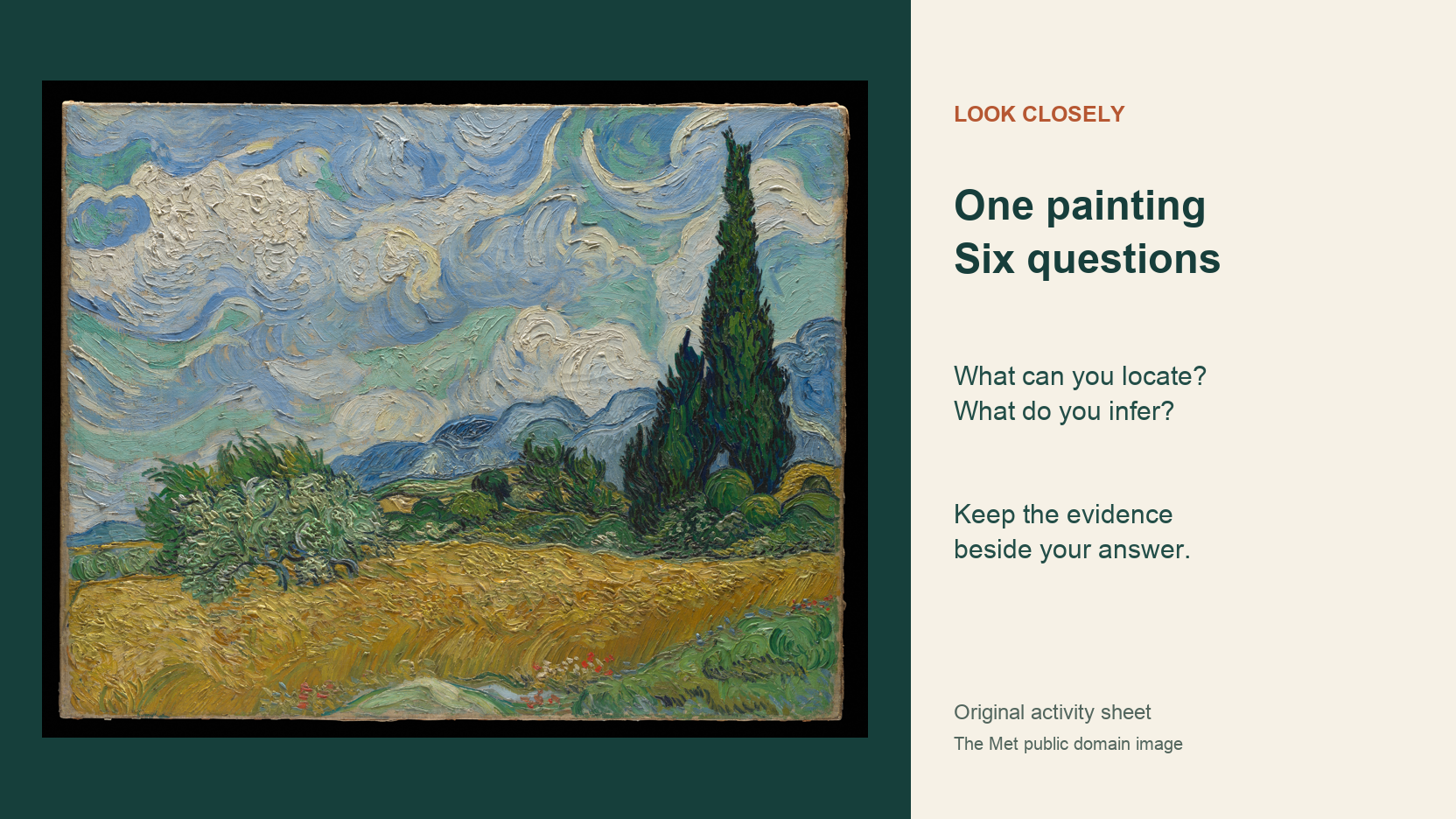
Use a digital jigsaw to pause over one painting, then return to the whole image with a few written observations. This art appreciation jigsaw activity pairs Vincent van Gogh’s Wheat Field with Cypresses with six original questions and a printable record sheet.
We checked the painting against The Metropolitan Museum of Art’s collection record. The six questions and sample responses below are our own activity. Compare your answers with ours while keeping room for your own reading of the painting.
Key takeaways
- 01Keep the same complete image before and after the puzzle.
- 02Describe a detail precisely enough for someone else to locate it.
- 03Connect interpretations to visible evidence and keep room for another reading.
Choose one work and record its source
The Met identifies Wheat Field with Cypresses as an 1889 oil painting by Vincent van Gogh, object number 1993.132. Its record marks the image Public Domain. The museum’s Open Access policy releases images of public domain works under CC0. Save the record address with your downloaded file.
Check the painting and its source record at The Met.
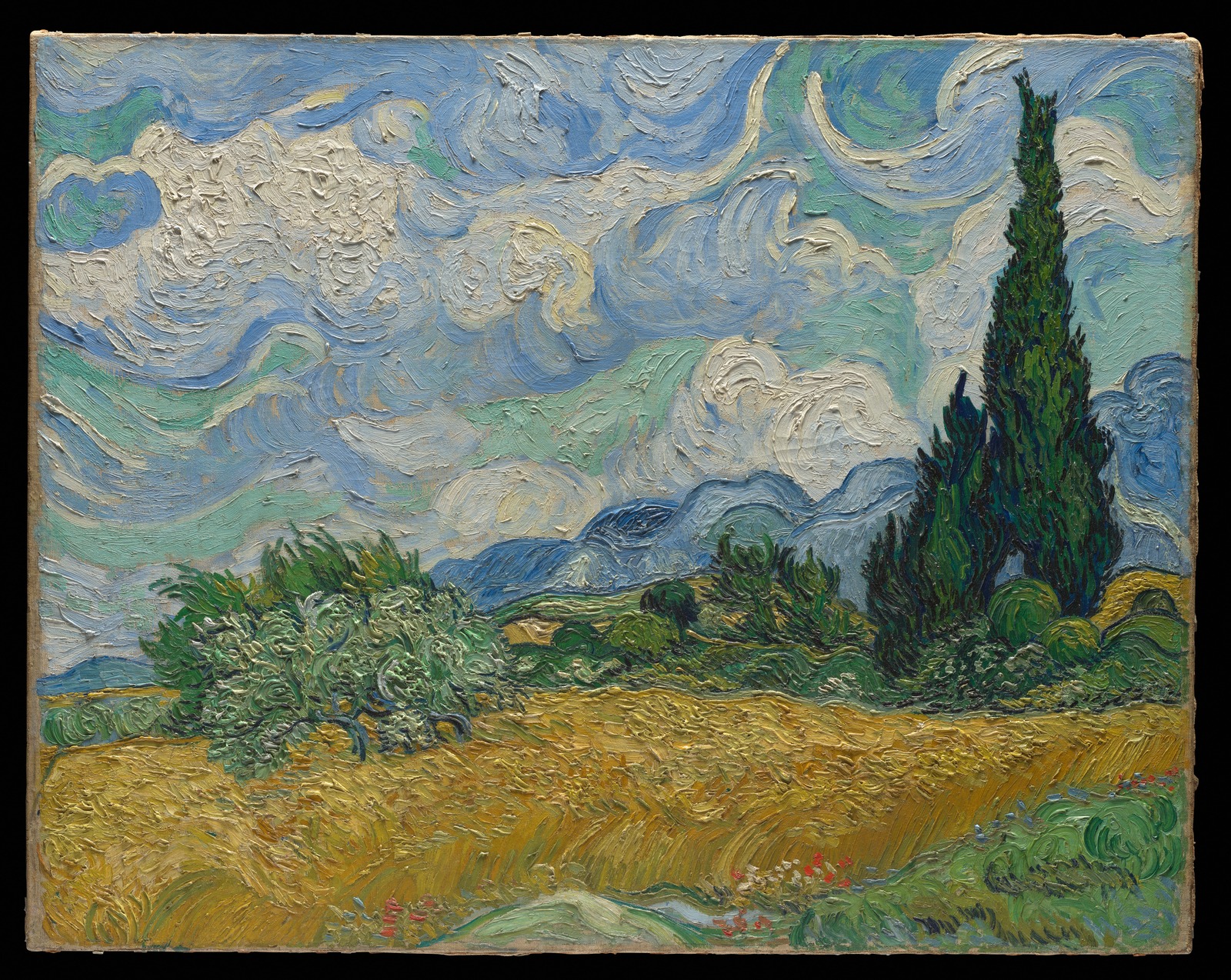
Download the painting JPEG for your own puzzle.
Look at the whole painting before reading the museum’s interpretation. Keep the title and date on your source note, but begin your description with shapes you can point to. This leaves you a record of your own first look before the accompanying text influences it.
Museums also use collection images as digital puzzles. Te Papa publishes a selection using its collections. The six questions here were written for this particular painting and are not a museum lesson or an assessment endorsed by either institution.
Notice three details before solving
Keep a notebook beside the screen or print the one-page sheet. Work alone for the first look, even if you will discuss it with someone later. Write a short answer to each question. A location such as upper right makes your observation easier to check than a general word such as beautiful.
- Where does your eye stop first? Name a color and its position in the picture.
- Which line can you follow across an area? Describe its direction and where it changes.
- How do the marks in two areas differ? Compare their length, shape or direction.
For the first question, one possible response is that the tall dark green shape on the right catches your eye against the pale sky. For the second, you might trace a broad white curve through the upper half. Neither response requires knowing the artist’s intentions. For the third, compare the broad pale curves in the sky with the shorter diagonal yellow marks in the field.
Download the one-page observation sheet to print.
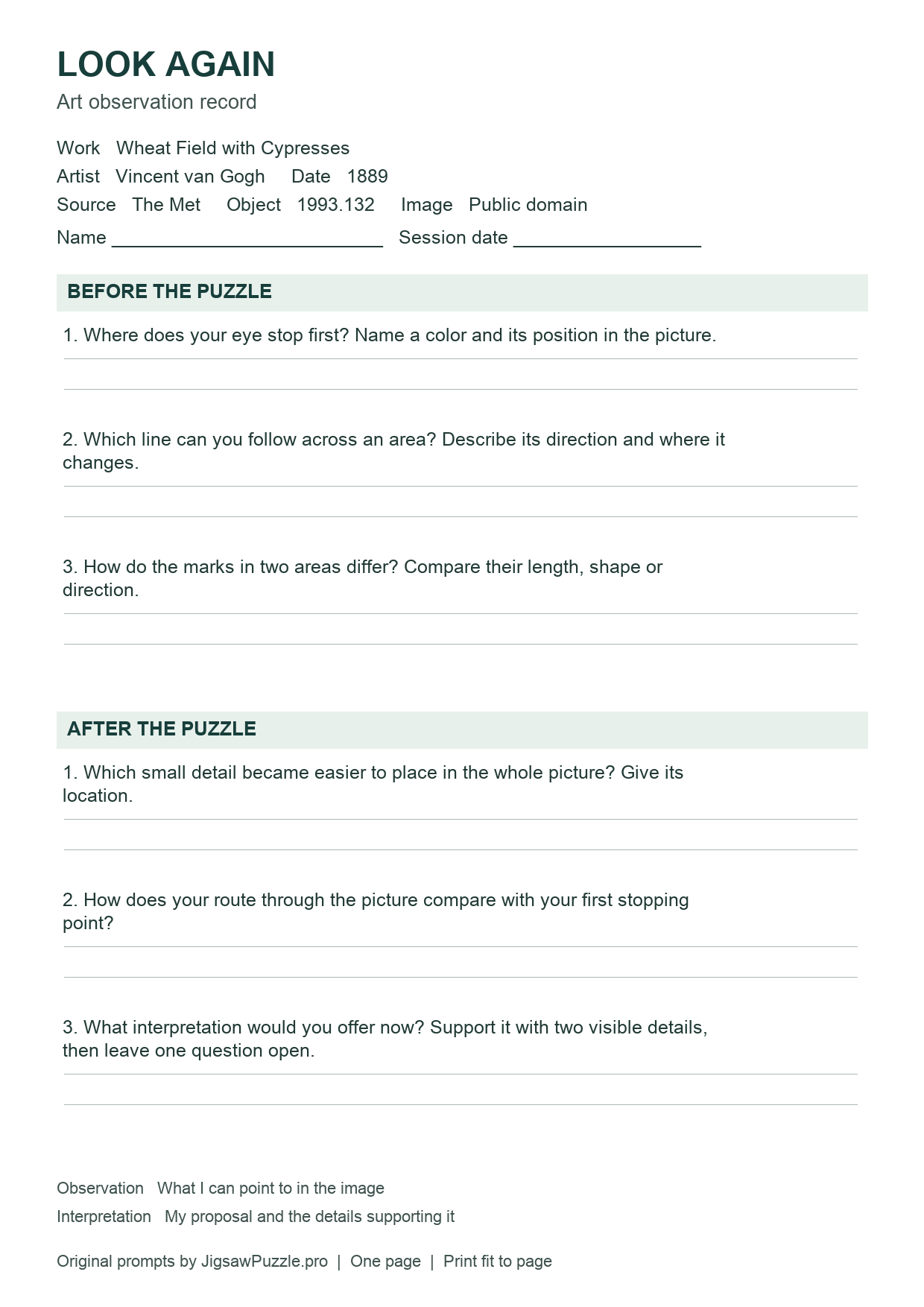
The sheet has room for the source, all six answers and a final distinction between observation and interpretation. Keep the first answers visible. If a later answer differs, add to the record rather than erasing the earlier one. That difference is useful material for the discussion.
Follow a detail through the puzzle
Save the supplied JPEG, open the DIY maker and select that file from your device. Choose 12 pieces for a short introduction or 24 if you want to spend longer comparing neighboring marks. These are activity choices, not measured learning levels. Use the complete image as your reference.
Open the DIY puzzle maker with your saved JPEG.
Use the photo puzzle tutorial for the file-to-board steps.
As you move pieces, name the detail you are following. A pale curl may continue onto another piece; short yellow strokes may sit beside longer green marks. Note where the join changes your understanding of that fragment. You can stop to look at the reference whenever you need it.
There is no speed target. If assembling pieces takes over the session, pause and return to the complete reference. The observation questions still work. Finish the board if you wish, then inspect the whole image again before answering the next three questions.
Compare details with the whole composition
- Which small detail became easier to place in the whole picture? Give its location.
- How does your route through the picture compare with your first stopping point?
- What interpretation would you offer now? Support it with two visible details, then leave one question open.
For the first answer, consider the small red marks near the lower edge. Seen alone, their relation to the scene is unclear. In the whole painting, you can place them among green and yellow foreground marks, below the distant blue ridge. That statement describes visible relationships without naming a plant.
Your eye might move from the dark vertical trees toward the curving clouds and down to the wheat. Someone else may begin with the bright field. Compare the routes by pointing to the image. Agreement about one focal point is unnecessary.
If discussing with a partner, read one original answer aloud and let the other person locate the detail. If they cannot find it, improve the position or description. This gives you a concrete revision to make without turning a difference in taste into a mistake.
Separate what you see from what you infer
| Kind of statement | Sample response |
|---|---|
| Observation | White and blue curves fill much of the sky; many yellow marks in the foreground lean diagonally. |
| Interpretation | The scene feels windy to me because the sky curves and leaning field marks suggest movement. |
| Alternative and question | The repeated curves may guide my eye even without describing weather. What does the museum’s account add? |
The interpretation is a proposal supported by two observations. It does not establish the weather or the painter’s state of mind. Another reader can accept the same visible marks and describe a different feeling. Ask which details support that reading before comparing it with the museum’s account.
Now return to the official record. Put any information learned there in a separate source note. Keep it distinct from your first observations. Completing this activity does not demonstrate mastery of art history or a cognitive improvement; the result is a small, inspectable record of looking.
This activity is intended primarily for adults. Players aged 13 to 17 should use the site under a parent or legal guardian’s supervision, as required by its terms. Keep the sheet for a later visit to the same painting and see which details you choose to describe then.
Sources and further reading
Frequently asked questions
Next move
Keep looking with a sourced image
Save the artwork credit beside your activity sheet.