
Puzzle history · From wooden maps to browser boards
How Jigsaw Puzzles Began with Dissected Maps
Quick summary
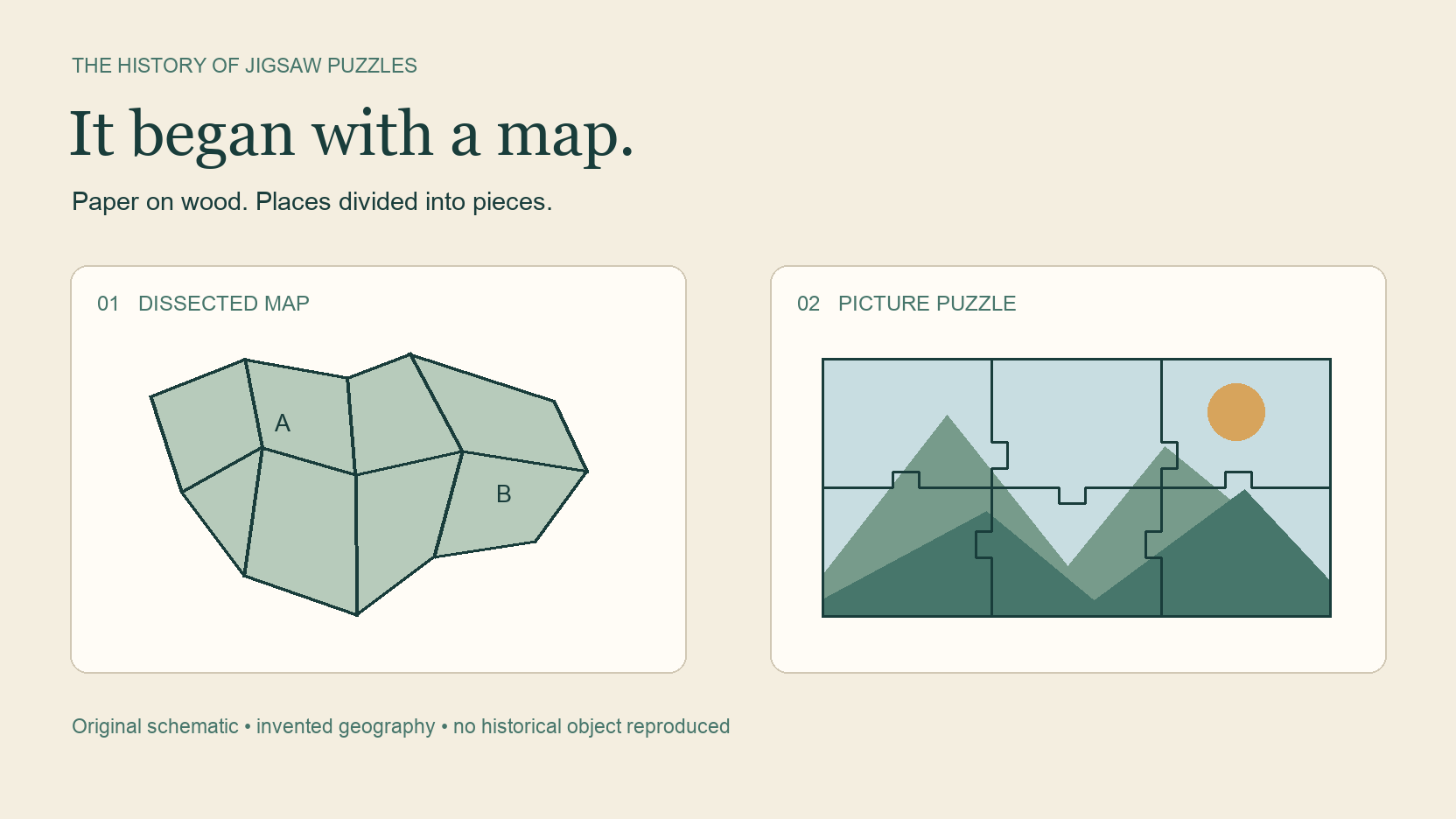
The history of jigsaw puzzles begins with maps mounted on wood and cut into pieces for geography lessons. Known as dissected maps, these puzzles asked children to rebuild places by fitting their outlines together. London mapmaker John Spilsbury is usually credited with the first commercial examples in the 1760s.
We compared museum accounts with surviving objects for this guide. Their dates need a little care. A museum can date a particular puzzle to 1766 while describing the wider beginning as around 1760. Keeping those claims separate makes the story easier to follow.
Key takeaways
- 01Dissected maps connected the shape of each piece with the place being learned.
- 02A dated surviving object gives firmer evidence than a single claimed invention year.
- 03New materials and pictures gradually widened the audience for puzzles.
Look at an early surviving map puzzle
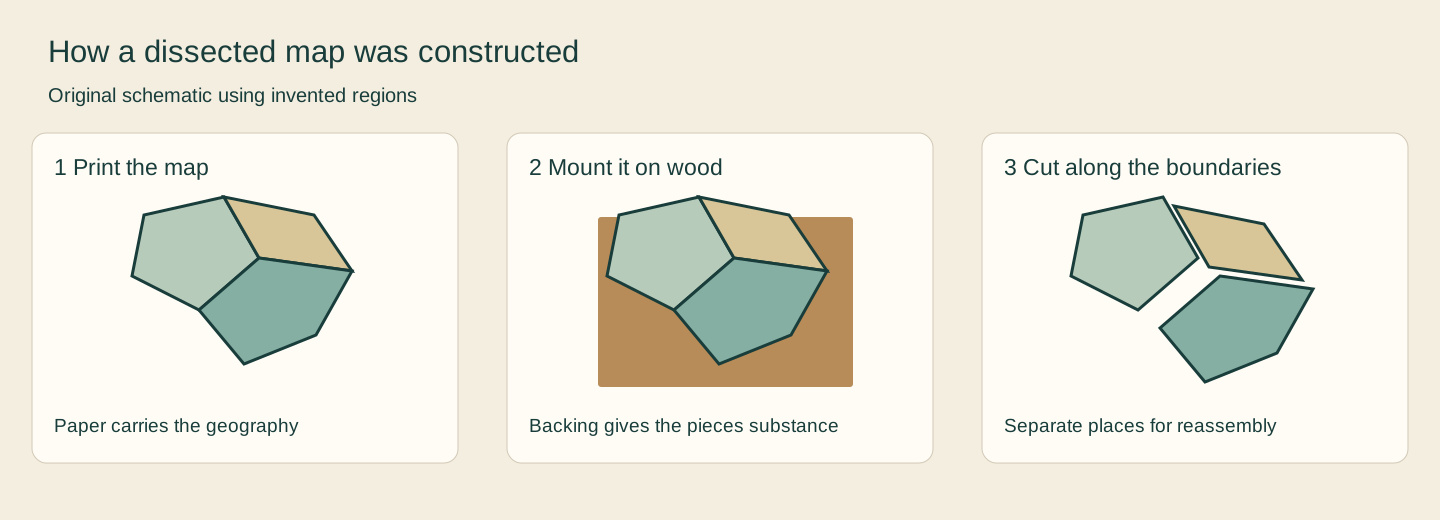
The Strong National Museum of Play holds Europe Divided into its Kingdoms, a Spilsbury map puzzle dated 1766. Conservator Carrie McNeal describes a printed map pasted onto thin mahogany and cut along geographical lines. The lesson was built into the cuts. Reassembling a country meant finding its position among its neighbors.
McNeal’s conservation account also explains why this fragile combination survived so well. The mahogany was radially cut, which helped it move evenly as humidity changed. The attached paper’s grain ran in the same direction as the wood. That reduced the risk of the two materials pulling against each other.
The construction gives you two things to look for when examining an old puzzle online. Notice where the printed lines meet a cut edge, then check whether the catalog describes the backing. A picture of the assembled front can hide much of the maker’s work.
Read The Strong’s conservation account of the 1766 puzzle.
Place Spilsbury in the wider story
Who invented the jigsaw puzzle? Spilsbury is the name most often given, though institutions phrase the credit differently. London Museum describes dissected maps as probably his invention. Europeana calls him the maker often credited with the first commercial jigsaw puzzle. Both place him within a history of educational mapmaking.
For Spilsbury’s puzzles, the useful starting point is the 1760s. A surviving example from within that decade gives us a firm point of reference. Its date alone cannot establish the exact year in which someone first tried cutting a map into pieces.
The name changed later too. Europeana connects “jigsaw” with the saw used to cut intricate shapes and places its association with puzzles around 1880, while acknowledging uncertainty about the timing. Spilsbury’s dissected maps came well before that later name became familiar.
See Europeana’s account of the commercial origins and later name.
Follow changes in materials and pictures
Map puzzles continued to circulate long after Spilsbury. The Library of Congress catalogs Mitchell’s Dissected map of the Middle States with a tentative publication date of 1854. It records 64 hand-colored paper-on-wood pieces and notes that its copy lacks two pieces. A missing-piece problem is recognizable across the centuries.
London Museum’s A New Dissected Map of the World, dated about 1860, shows another part of the trade. William Peacock made and sold the puzzle using a map engraved by George Frederick Cruchley. Peacock bought maps from other publishers. Printing the image and manufacturing the puzzle could be separate businesses.
The museum records hand-colored countries and a revealing error. On the globe depicting the Americas, the Atlantic is labeled as the Pacific. Its description also identifies colonial imagery on the box. Such details make an old puzzle a source for studying the assumptions and mistakes in the picture being assembled.
Subjects expanded to include pictorial scenes and nursery rhymes. Later, The Strong records Parker Brothers introducing Pastime Puzzles in 1908, with pieces shaped as animals or letters. The 1930s brought inexpensive, mass-produced cardboard puzzles and weekly editions sold at newsstands. Pictures and unusual cuts could attract adults as well as children.
Inspect the Library of Congress record for Mitchell’s map puzzle.
Explore London Museum’s approximately 1860 world map puzzle.
A short timeline with the evidence kept visible
| Date or period | What the source supports | Evidence |
|---|---|---|
| 1760s | Spilsbury’s commercial dissected maps | Europeana’s historical attribution |
| 1766 | Europe Divided into its Kingdoms | Dated object described by The Strong |
| About 1860 | Peacock’s world map puzzle | London Museum object 58.94/16 |
| 1908 | Parker Brothers Pastime Puzzles | The Strong’s history of the toy |
| 1930s | Cheap die-cut cardboard puzzles sold widely | The Strong’s account of mass production |
Read the first row as a period of commercial activity. The next two rows concern particular surviving puzzles. Later rows describe products and production changes. Together they show the development without turning every milestone into a claim about who was first.
Read The Strong’s overview of puzzle manufacturing and popularity.
Connect the old idea to a browser puzzle
A browser puzzle still asks you to inspect fragments and reconstruct a picture. The relationship between cuts and subject has changed. In a dissected geography map, a boundary can define a piece. In a modern landscape puzzle, a single piece can cross from sky into mountain, leaving color and line as clues.
On JigsawPuzzle.pro, choose a gallery picture and select a difficulty. Easy has 12 pieces. Open the reference image and compare one distinct feature with its fragment on the board. This gives you a small, practical way to notice how the picture guides assembly.
Choose a picture from the free puzzle gallery.
For a personal image, use the photo tutorial before preparing your board. Start with a low piece count so you can see which details survive the cuts. If a roofline crosses two pieces, try using that line to decide how they belong together.
Sources and further reading
Frequently asked questions
Next move
Choose your next picture
Browse the gallery and try a small board, or learn how to prepare a personal photo.