
Puzzle vocabulary · Put a name to the shape
Jigsaw Puzzle Piece Names Explained with a Labeled Diagram
Quick summary
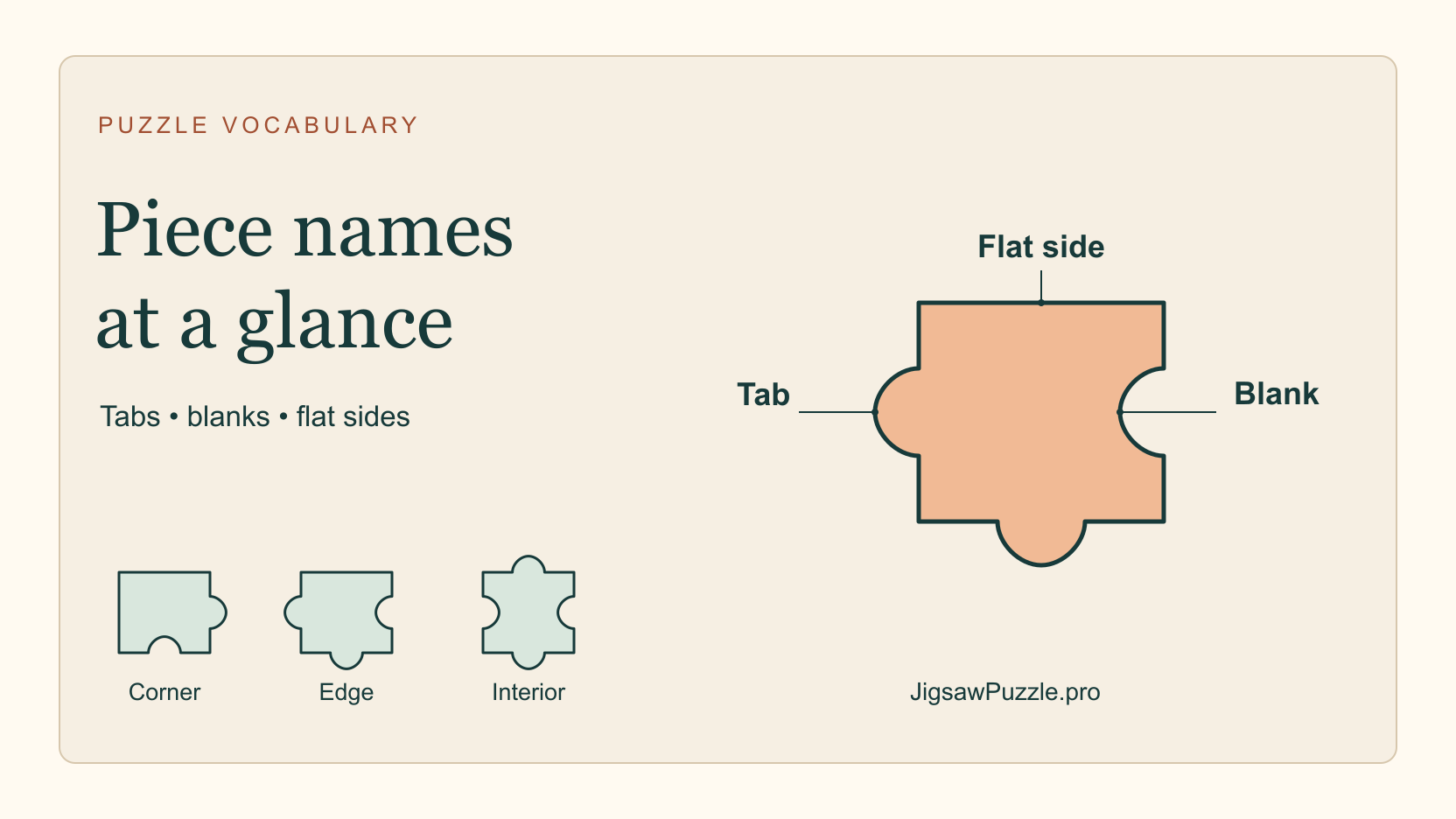
The parts that stick out of a jigsaw puzzle piece are usually called tabs. The inward cutouts are blanks. On a conventional rectangular puzzle, flat border sides help you identify edges and corners. Those names give you a clearer description than “the blue one.”
We checked the vocabulary against Puzzle Warehouse and Cloudberries. Both use tabs and blanks, while Cloudberries also records several informal alternatives. The drawings below are original teaching examples, with six pieces you can describe without depending on their color.
Key takeaways
- 01A tab projects outward; a blank curves inward.
- 02Corners have two adjacent border sides on an ordinary rectangular puzzle.
- 03Give the position of each feature as well as its name.
Name the features on one piece
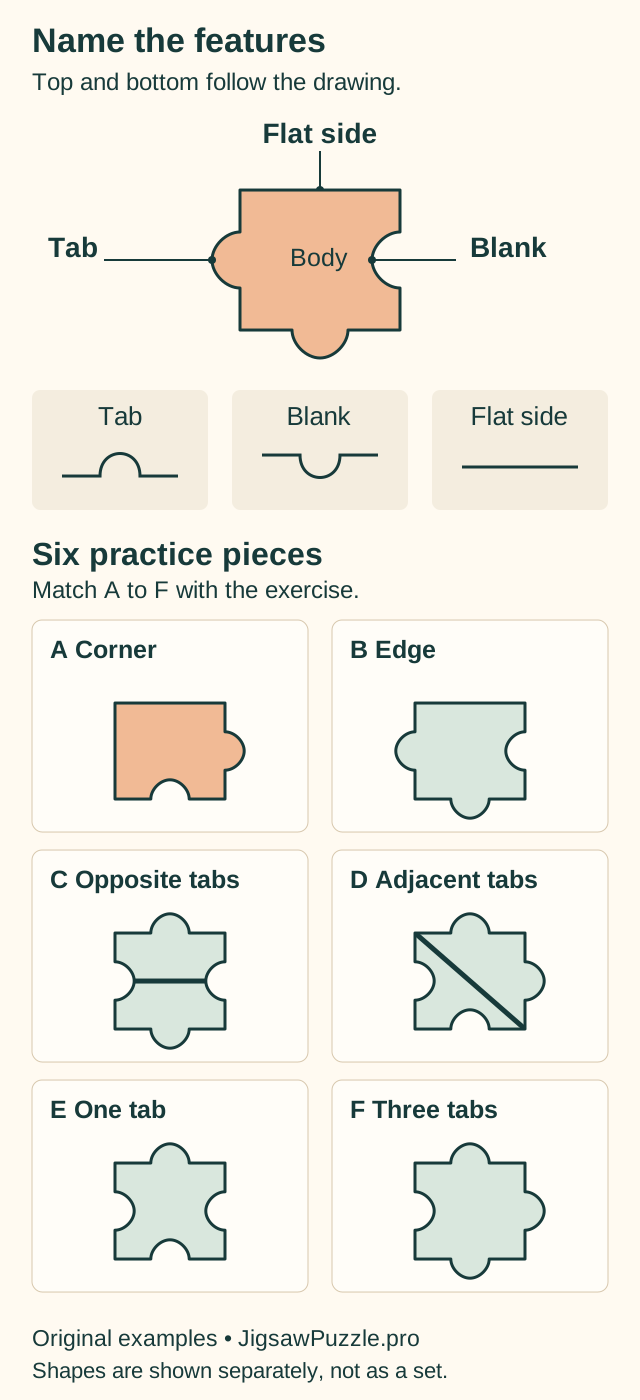
Look at the enlarged edge piece in the diagram. Its left side has a tab that bulges beyond the main outline. Its right side has a blank that cuts into the outline. Along the top, a flat side forms part of the finished picture’s border.
| Name | Feature to look for |
|---|---|
| Tab | An outward projection that fits into a neighboring blank. |
| Blank | An inward cutout that receives a neighboring tab. |
| Flat side | A straight border side with no tab or blank. |
| Body | The main area of the piece, carrying part of the picture. |
One piece can have several tabs and blanks. Calling it “a tab piece” leaves the other sides unspecified. “Two tabs on opposite sides” tells the other person more.
Body is a plain description of the central area. For finer details, ordinary words work well. You can describe a tab as having a wide rounded end or a narrow base.
Distinguish corners, edges and interior pieces
Corner, edge and interior describe where a whole piece belongs. On a conventional rectangular jigsaw, examine the sides that form the outside border.
- A corner piece has two adjacent flat border sides. Piece A has them at the top and left.
- An edge piece away from a corner has one flat border side. Piece B has it at the top.
- An interior piece has no outside border side. Pieces C through F illustrate four possible outlines.
Border piece means a piece on the outside boundary. Someone talking about edge pieces may include corners in that group. When the distinction matters, say “corner” or “edge piece with one flat side.”
Keep that rectangular-puzzle condition in mind. A circular or shaped puzzle can have a curved outer boundary. An unusually cut puzzle may also contain straight cuts inside the picture. For those designs, describe the actual boundary you see rather than applying the flat-side rule automatically.
Understand common informal names
Cloudberries lists knob and loop as alternatives for tab, and socket, slot and hole for blank. A hole in this sense opens from the side of the piece. The word describes that indentation.
Innies and outies are informal names for blanks and tabs. An innie goes inward; an outie points outward. They are easy to remember across a puzzle table. Tabs and blanks are useful when writing for someone unfamiliar with your household’s vocabulary.
Cloudberries also calls the one-tab, three-blank outline a dancing man. Piece E shows that arrangement. Treat this as the glossary’s nickname. Another puzzler may use a different name, so give the tab count too.
A whimsy piece has a recognizable outline such as a bird or flower. Wentworth uses these shapes in many of its wooden puzzles. Whimsy describes the whole special silhouette. It is a separate term from tab or blank, and JigsawPuzzle.pro’s current rectangular boards use ordinary connecting pieces without whimsy silhouettes.
Describe a piece without relying only on color
To identify the whole cutting layout, compare ribbon and random cuts with the boundary diagrams.
Start with the piece type, then say where its tabs and blanks sit. Add a picture detail if you need to distinguish it from another piece with the same outline. A line across the middle is more specific than a broad color label.
Agree on orientation before using left and right. For these exercises, use the drawings as displayed. With a physical piece, place it in the same orientation as the diagram first. “Two tabs” alone cannot distinguish C from D, because their tabs occupy different sides.
- A is a corner piece with flat top and left sides, a tab on the right and a blank at the bottom.
- B is an edge piece with a flat top, tabs on the left and bottom, and a blank on the right.
- C is an interior piece with opposite tabs at the top and bottom, blanks on the left and right, and a line across its middle.
- D has adjacent tabs at the top and right, blanks at the bottom and left, and a diagonal line from upper left to lower right.
- E has one tab at the top and blanks on its other three sides.
- F has tabs at the top, right and bottom, with its only blank on the left.
Cover the sentences and describe each outline aloud. Then compare your words with the drawing. If you gave C adjacent tabs, trace its boundary again and locate each outward curve.
For a short practice session, choose a gallery picture on JigsawPuzzle.pro and begin with 12 pieces. Describe one corner and one edge before moving them. The current game keeps pieces in their original orientation, so the same top and bottom remain available while you drag.
Choose a gallery picture and practice naming the pieces.
For help placing those pieces, continue with the online solving guide.
Sources and further reading
Frequently asked questions
Next move
Put the names to work on a small puzzle
Choose a picture, identify a corner and an edge, then describe their tabs and blanks before placing them.